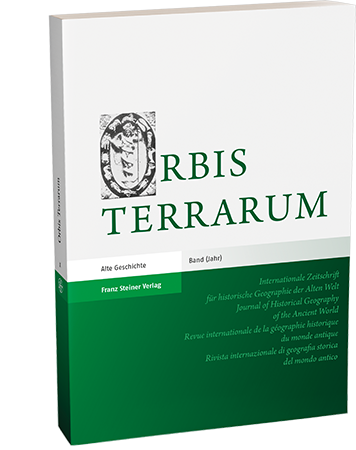
Orbis Terrarum
Internationale Zeitschrift fuer historische Geographie der Alten Welt / Journal of Historical Geography of the Ancient World / Revue internationale de la géographie historique du monde antique / Rivista internazionale di geografia storica del mondo antico
With Orbis Terrarum the Ernst-Kirsten-Society provides an interdisciplinary forum for research on the historical geography of classical antiquity. The spectrum is broad by design: Studies on the geographical-topographical profile may be found here as well as studies on the historical interaction between mankind and the environment, essays on the history of science or methodological studies.
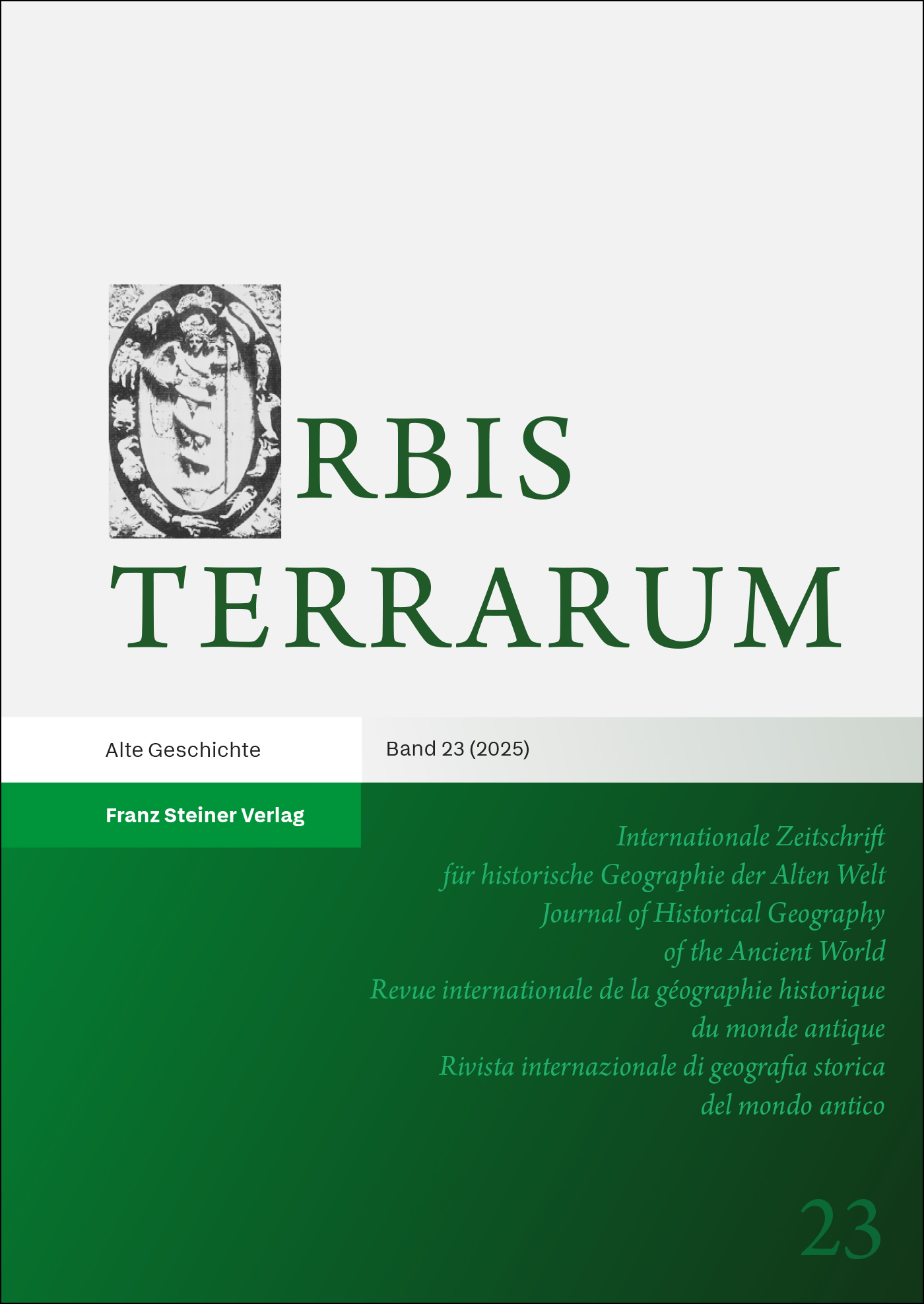
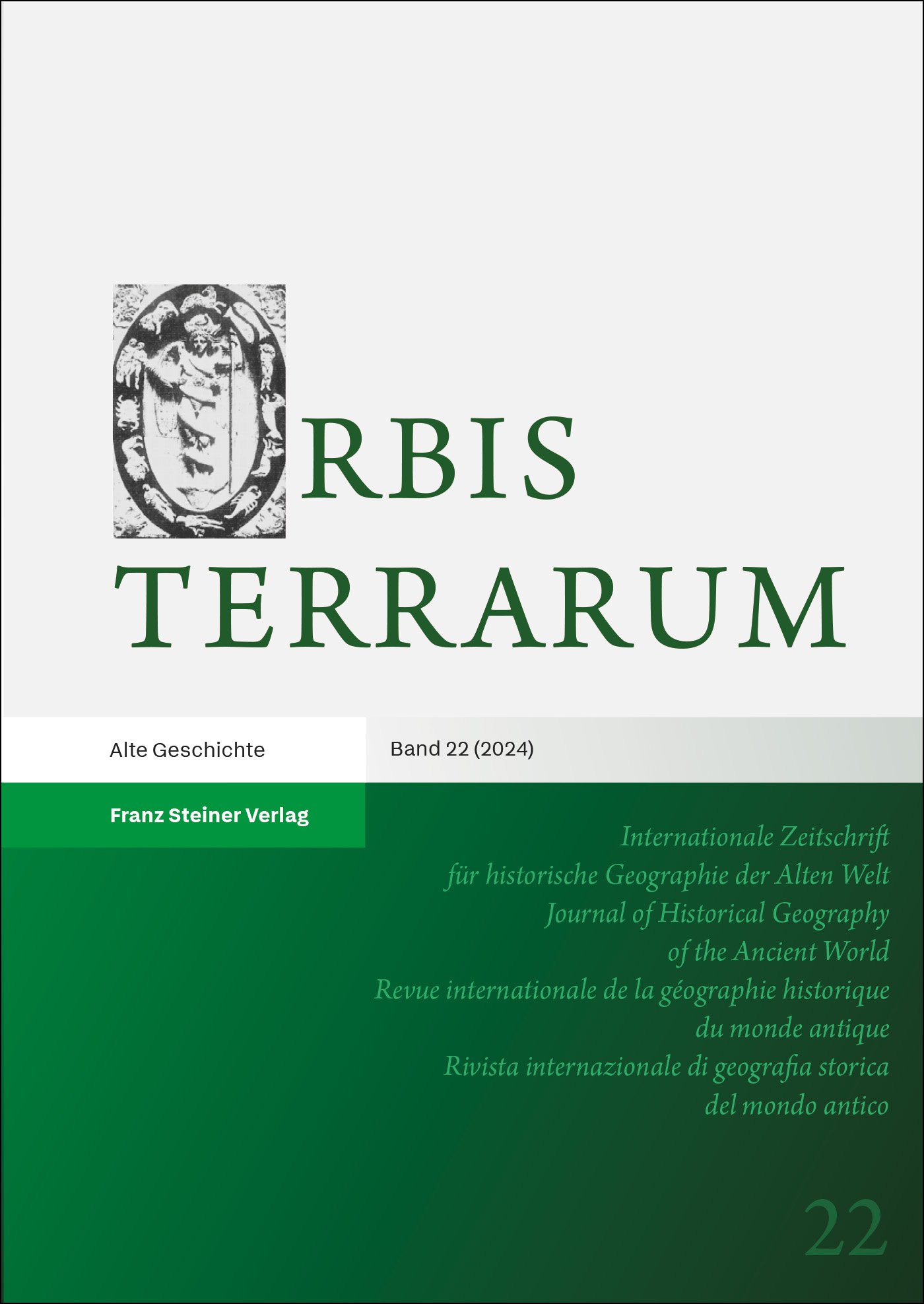
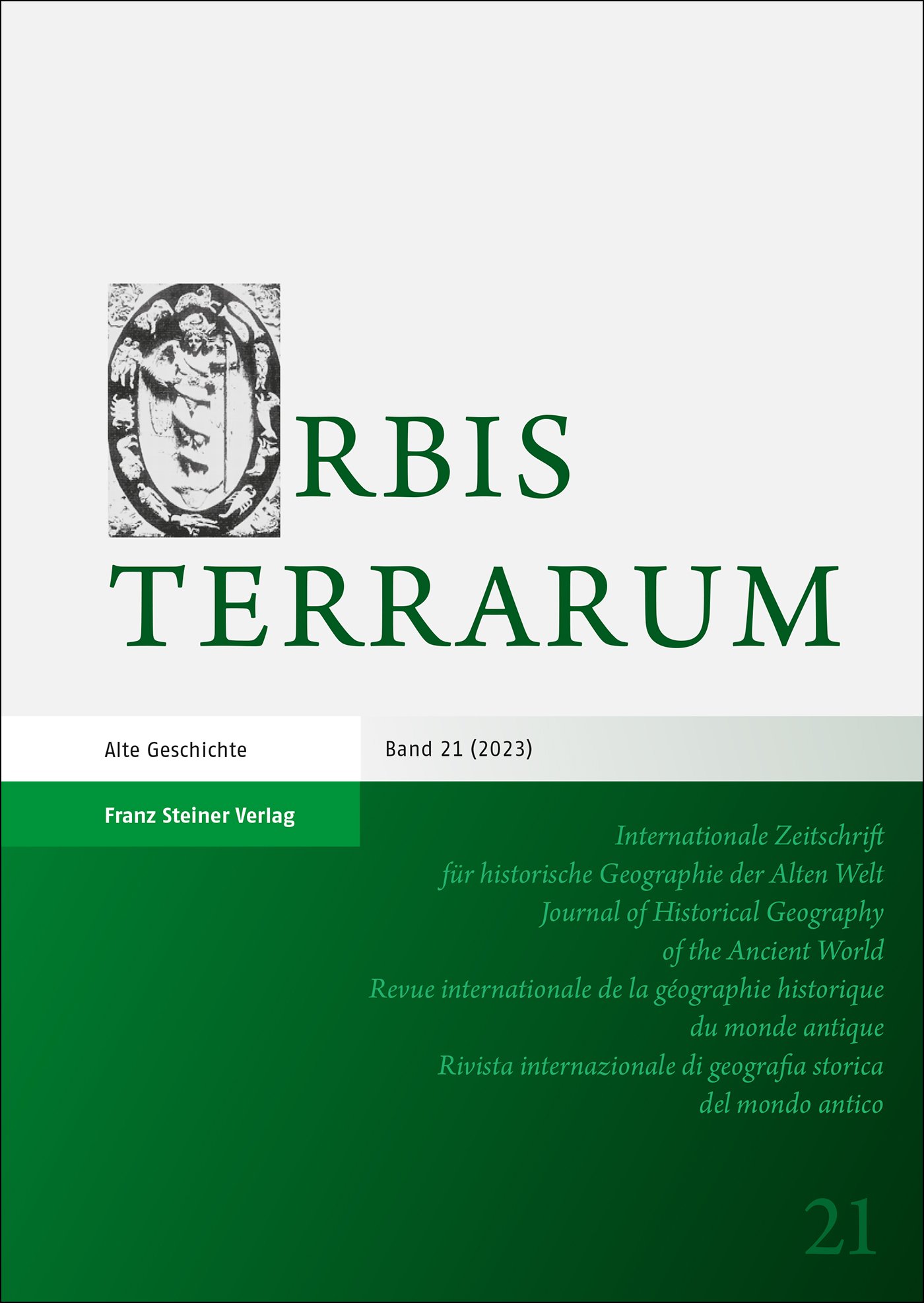
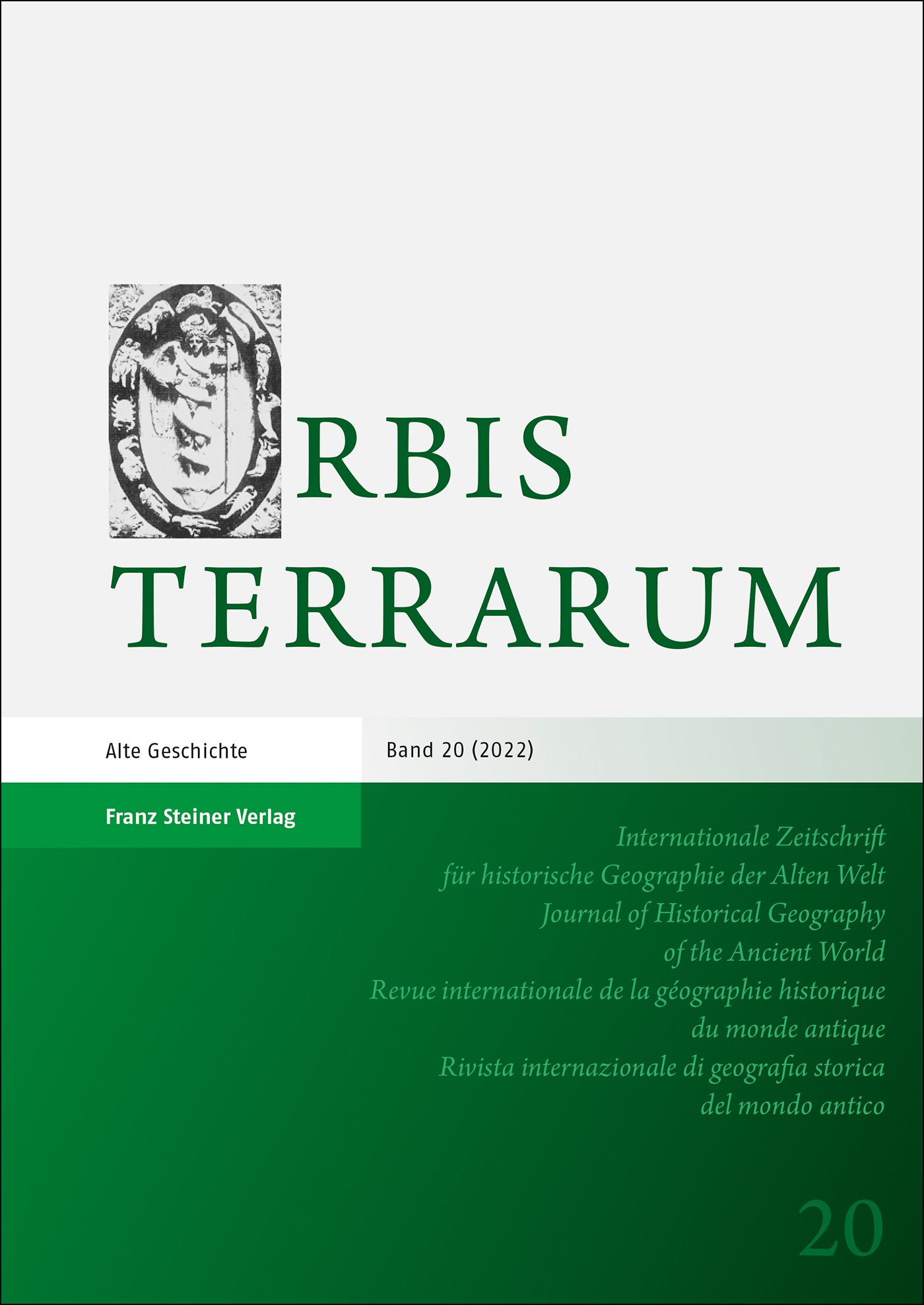
Although the world of classical antiquity remains the primary focus of Orbis Terrarum, its gaze may also turn to earlier or later historical eras. Thus, historical or geographical aspects of the territory of the ancient world in earlier or later historical eras find room in Orbis Terrarum as well. This broad thematic scope is symbolized by the cosmic motif of the journalʼs logo.
Edited
On behalf of the Ernst-Kirsten-Gesellschaft: Internationale Gesellschaft fuer Historische Geographie der Alten Welt by
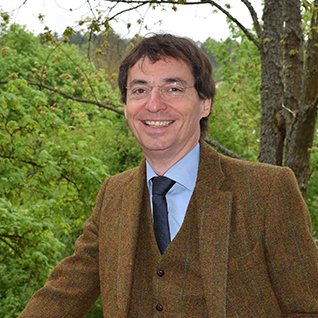
Prof. Dr. Michael Rathmann
(executive editor)
Universität Eichstätt-IngolstadtLehrstuhl für Alte Geschichte
Universitätsallee 1
85072 Eichstätt
DEUTSCHLAND michael.rathmann@ku.de
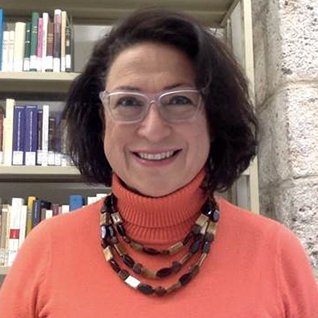
Prof. Dr. Veronica Bucciantini
(Reviews)
Università degli Studi di FirenzeDipartimento di Lettere e Filosofia (DILEF)
Professore Associato di Storia Greca
Via della Pergola 58–60
50121 Firenze
ITALIA veronica.bucciantini@unifi.it
Prof. Dr. Frank Daubner
(Reviews)
Universität TrierFachbereich III – Alte Geschichte
54286 Trier
DEUTSCHLAND daubner@uni-trier.de
Advisory board
Pascal Arnaud (Lyon), Serena Bianchetti (Firenze), Angelos Chaniotis (Princeton), Gonzalo Cruz Andreotti (Málaga), Anca Dan (Paris), Daniela Dueck (Ramat Gan), Hans-Joachim Gehrke (Freiburg), Francisco J. González Ponce (Sevilla), Herbert Graßl (Salzburg), Anne Kolb (Zürich), Andreas Külzer (Wien), Ray Laurence (Sydney), Felix K. Maier (Zürich), Francesco Prontera (Perugia), Vera Sauer (Rangendingen), Mustafa Sayar (Istanbul), Pierre Schneider (Arras)
Founded by
Eckart Olshausen
Orbis Terrarum
General information
ISSN 1385-285X (print)
ISSN 2748-257X (online)
Founded: 1995
Publication frequency: annual
Size: 17 x 24 cm
Annual number of pages: ca. 300
Languages: English, French, German, Italian
Review section: Yes
Validation: double blind peer review
- Dietrich’s Index Philosophicus
- Dimensions
- Elenchi di riviste scientifiche e di classe A (Agenzia Nazionale di Valutazione)
- ERIH – European Reference Index for the Humanities
- IBR / IBZ
- Naver Academic
- Norwegian Register for Scientific Journals, Series and Publishers
- Ulrichs web
- H-Soz-Kult
Publishing information
Please send manuscript submissions to the editor-in-chief. Submissions must be original articles (no translations) which must not be previously published. During the review process, manuscripts may not be submitted elsewhere. A manuscript submitted to the journal must be ready for publication, the editors do not accept partial or draft versions. In initial submissions, the citation rules of the journal do not have to be strictly followed. Please pay attention to the anonymization of your text so that your identity as author cannot be ascertained directly or indirectly (e.g. by acknowledgments and self-references in footnotes).
All submissions are subjected to double blind peer review. The review process can result in acceptance, the recommendation of revisions or rejection of the manuscript. The author is informed of the decision by email. The editors attempt to reach a decision within 3 months of the submission of the manuscript.
If a manuscript is accepted, the editors request a file with the final version. The final version includes names and acknowledgments. Also, please follow the guidelines of publisher and editors provided below.
There are no fees for submitting and publishing an article in the Yearbook.
In our area for authors you will find all the general information you need about structuring your article, formatting your text, working with images and tables and so on. Here we have linked the most important pages for you:
- Technical requirements
- Contribution guidelines
- Text body
- Figures and images
- Tables
- Lists and bibliography
- Use of AI
Additional editorial information and citation guidelines
Contribution header
- General guidelines on the contribution header can be found under ‘Contribution guidelines’.
- In Orbis Terrarum, the title in the original language is followed by the English translation of the title, unless the title is already in English.
- Abstract and keywords in English are mandatory. There are no abstracts and keywords in the original language.
Special text markups
- Please italicize transliterated Latin, except for names of people or places, names of ships and military units, as well as texts, books, and magazines.
Please avoid using bold type or underlining to highlight text.
Abbreviated references in the footnotes
- Sources and references are given in the footnotes in abbreviated form, and the detailed bibliographic information is provided in a bibliography at the end of each contribution
- For ancient authors and work titles, please use the abbreviations from Der Neue Pauly or The Oxford Classical Dictionary, e.g., Plin. nat. or Plin. HN.
- Please cite ancient work titles in italics, e.g., Tac. Ann. 3,60–63.
- When citing ancient texts, please use Arabic numerals, e.g. Hdt. 4,117,1 instead of Hdt. IV,117,1.
- Please use the chosen abbreviation for ancient works consistently.
- The short title is cited as follows: Last Name Year, page number.
Schnurbein 1991, 3.
Bibliography
- Please italicize all work titles.
- Please separate multiple authors or places with commas.
- Works in foreign languages (e.g., Greek, Cyrillic) do not need to be latinized.
- Please use small caps for authors’ names (capitalized in the following examples).
Monograph
- X. LAST NAME, Title. Subtitle, Place Year.
P. ARNAUD, Les routes de la navigation antique. Itinéraires en Méditerranée, Paris 2005.
Contribution in an edited volume
- X. LAST NAME, Title. Subtitle, in: X. LAST NAME (ed.), Title. Subtitle, Place Year, Page number.
K. GEUS, Die Geographika des Eratosthenes von Kyrene: Altes und Neues in Terminologie und Methode, in: M. RATHMANN (ed.), Wahrnehmung und Erfassung geographischer Räume in der Antike, Mainz 2007, 11–122.
Contribution in a journal
- X. LAST NAME, Title. Subtitle, in: Title Volume, Issue Year, Page number.
M. SCHUOL, Indien und die großen Flüsse auf der Tabula Peutingeriana: Die östliche Oikumene zwischen paganer und christlicher Kartographie, in: Orbis Terrarum 14, 2016, 92– 154.
Please see our information on copyright, self-archiving rules and guidelines for the use of PDF reprints here:
For our publication ethics statement have a look here:
Discover the journal
Subscribe
For institutions: Do you wish to subscribe to Orbis Terrarum? Please get in contact with us and write to us here:
For private customers:
Latest issues
-
€112.00*
-
€112.00*
-
€112.00*
-
€112.00*
-
€112.00*
-
€112.00*
-
€112.00*
-
€112.00*
-
€112.00*
-
€112.00*