Language and Power in the Roman Empire and Early India
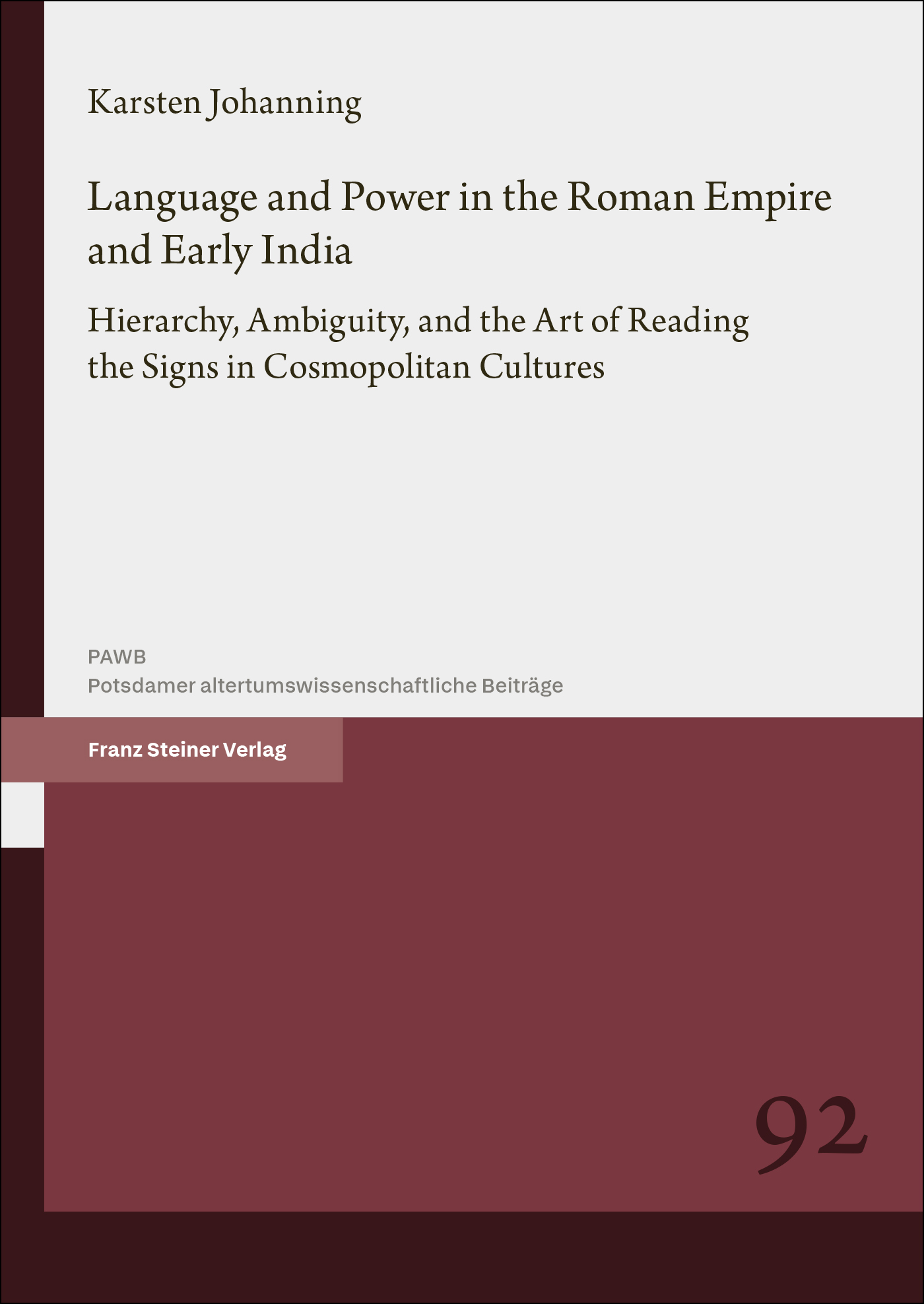
Attempting to bypass earlier and present discussions about Romanization, identity, and globalization, this book confronts the issue of cultural elite integration in the early Roman Empire in a new way by focussing on prestige language as a connecting factor in a Eurasian context. Thus, through a comparison with a central period in early Indian history (around 300 BC–AD 600), Karsten Johanning seeks to add perspectives from Sanskrit to the Greco-Roman cosmopolitanism of both emperors and intellectuals.
Four case studies are structured around different types of signs: on the body, in fictitious literature, in religious discourse, and in topography. Drawing on these, Johanning shows that for cosmopolitans in Rome and India, the ability to read and interpret signs in different contexts was essential for creating both cosmopolitan life-worlds, distinction, and social boundaries. Ancient cosmopolitans, well versed in different intertextual systems, were therefore able to make the most out of the complex hierarchies and inherent ambiguities of the premodern world. Yet the social stakes were always high, especially at the competitive and volatile imperial courts of universal rulers.
| Series | Potsdamer altertumswissenschaftliche Beiträge |
|---|---|
| Volume | 92 |
| ISBN | 978-3-515-14153-6 |
| Media type | Book - Paperback |
| Edition number | 1. |
| Copyright year | 2026 |
| Publisher | Franz Steiner Verlag GmbH |
| Length | 257 pages |
| Size | 17.0 x 24.0 cm |
| Language | English |