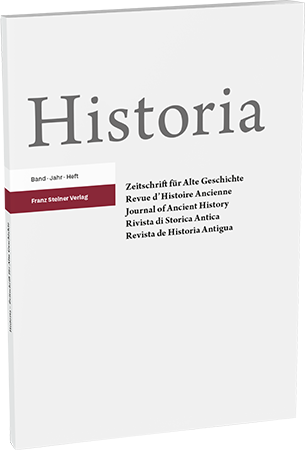
Historia
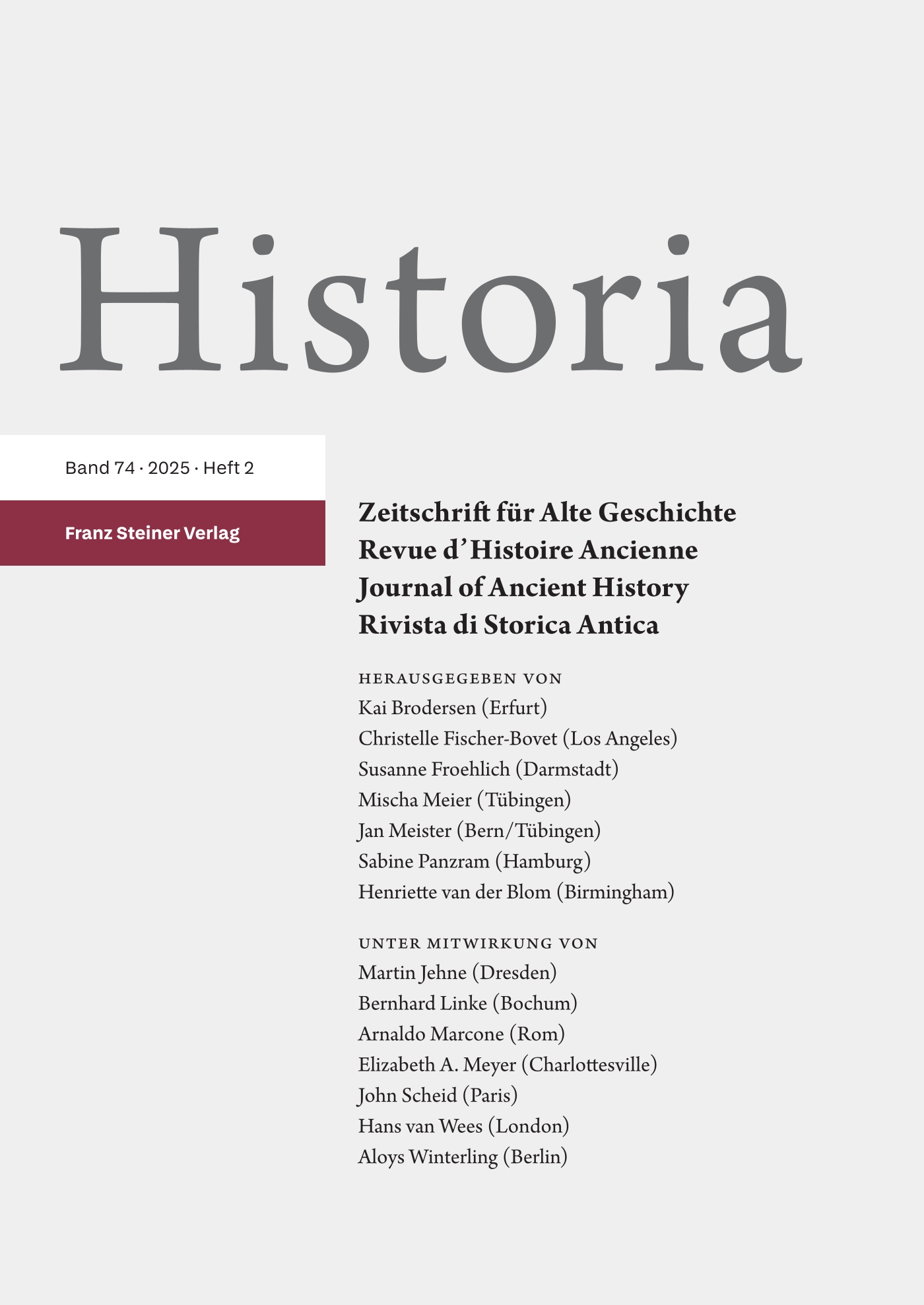
Zeitschrift fuer Alte Geschichte / Revue dʼHistoire Ancienne / Journal of Ancient History / Rivista di Storia Antica / Revista de Historia Antigua
Historia is dedicated to research on the entire period of Greco-Roman antiquity, i.e. Archaic and Classical Greece, the Hellenistic period, the Roman Republic, the Roman Empire and Late Antiquity. It includes not only political, economic and social history but also archeological, numismatic and epigraphic topics as well as the history of religion and law.
Historia was founded after the Second World War by the German ancient historian Karl Friedrich Stroheker and the Swiss ancient historian Gerold Walser, not least of all to revive international dialog. It publishes original articles in English, German, French and Italian. Today it is one of the most highly respected and frequently cited ancient history research journals worldwide, whereas the supplement series features seminal monographs in the field.
Edited by

Prof. Dr. Kai Brodersen
(editor-in-chief until 2026/4)
Universität ErfurtAntike Kultur historia@uni-erfurt.de

Prof. Dr. Christelle Fischer-Bovet
University of Southern CaliforniaDepartment of Classics fischerb@usc.edu
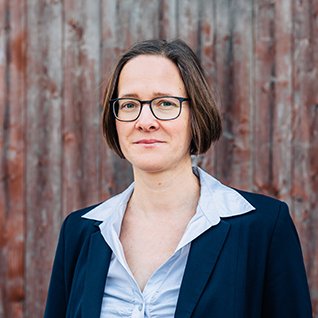
Prof. Dr. Susanne Froehlich
Universität ErfurtHistorisches Seminar
Geschichte der Mobilitäten susanne.froehlich@uni-erfurt.de

PD Dr. Matthias Haake
Universität BonnInstitut für Geschichtswissenschaft / Alte Geschichte mhaake@uni-bonn.de
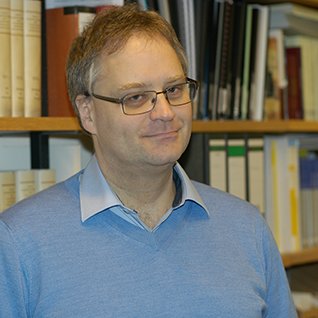
Prof. Dr. Mischa Meier
Universität TübingenSeminar für Alte Geschichte mischa.meier@uni-tuebingen.de

Prof. Dr. Jan Bernhard Meister
Universität BonnInstitut für Geschichtswissenschaft / Alte Geschichte jan.meister@uni-bonn.de
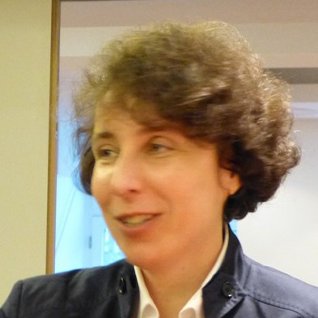
Prof. Dr. Sabine Panzram
(editor-in-chief as of 2027/1)
Universität HamburgHistorisches Seminar
Arbeitsbereich Alte Geschichte sabine.panzram@uni-hamburg.de

Prof. Dr. Henriette van der Blom
University of BirminghamDepartment of Classics, Ancient History and Archaeology
Edgbaston h.vanderblom@bham.ac.uk
Advsisory board
Prof. Dr. Martin Jehne (Dresden)
Prof. Dr. Bernhard Linke (Bochum)
Prof. Dr. Arnaldo Marcone (Rom)
Prof. Dr. Elizabeth A. Meyer (Charlottesville)
Prof. Dr. John Scheid (Paris)
Prof. Dr. Hans van Wees (London)
Prof. Dr. Aloys Winterling (Berlin)
Historia
General information
ISSN 0018-2311 (print)
ISSN 2365-3108 (online)
Founded: 1950
Publication frequency: quarterly
Size: 17 x 24 cm
Annual number of pages: ca. 512
Languages: English, French, German, Italian, Spanish
Review section: No
Validation: double blind peer review
- Linguistic Bibliography (Online)
- Arts & Humanities Citation Index (A&HCI)
- Current Contents Arts & Humanities
- Dietrich’s Index Philosophicus
- Internationale Bibliographie der geistes- und sozialwissenschaftlichen Zeitschriftenliteratur (IBZ)
- Internationale Bibliographie der Rezensionen geistes- und sozialwissenschaftlicher Literatur (IBR)
- New Testament Abstracts Online
- Scopus
- SCImago
- Article first
- Periodicals Index Online (PIO)
- ProQuest Central
- Research Library
- PubMed
- Ulrichs web
- JournalGuide
- Journal Citation Reports (JCR)
- ERIH PLUS
- Google Scholar
- H-Soz-Kult
Publishing information
Please send manuscript submissions to the editor-in-chief as of 2027. Submissions must be original articles (no translations) which must not be previously published. During the review process, manuscripts may not be submitted elsewhere. A manuscript submitted to the journal must be ready for publication, the editors do not accept partial or draft versions. We recommend a length of 8,000 to 12,000 words (including footnotes and bibliography). In initial submissions, the citation rules of the journal do not have to be strictly followed. Please pay attention to the anonymization of your text so that your identity as author cannot be ascertained directly or indirectly (e.g. by acknowledgments and self-references in footnotes).
All submissions are subjected to double blind peer review. The review process can result in acceptance, the recommendation of revisions or rejection of the manuscript. The author is informed of the decision by email. The editors attempt to reach a decision within 3 months of the submission of the manuscript.
If a manuscript is accepted, the editors request a file with the final version. The final version includes names and acknowledgments. Also, please follow the guidelines of the publisher provided below.
There are no fees for submitting and publishing an article in the journal.
In our area for authors you will find all the general information you need about structuring your article, formatting your text, working with images and tables and so on. Here we have linked the most important pages for you:
Additional editorial information and citation guidelines
Abbreviated references in the footnotes
- Bibliographical references given in the footnotes follow the author year-system (Harvard).
- For Spanish authors, please always indicate all given surnames:
“Murillo Redondo 2013, 43”
not “Murillo 2013, 43” - If you are citing a work with more than two authors, set “et al.”:
“Murillo Redondo et al. 2009–2010. - Ancient authors are abbreviated by the standards of TLL (Thesaurus Linguae Latinae) and TLG (Thesaurus Linguae Graecae) or if you don’t have access to the TLG: Brill’s New Pauly
eg. Plin. nat. 18.4.17
not Plin. NH 18.4.17 - Arabic and other medieval authors are cited in the shortest variant possible:
al-Rāzī, Ajbār mulūk Al-Andalus (ed. Menéndez Pidal and Soledad de Andrés 1975)
Bibliography
- The bibliography is organized alphabetically according to author surname.
- More than one work of the same author are sorted by publication date, starting with the latest publication.
- First names are not abbreviated. Last name prepositions, articles and filiation components – i.e. “von”, “de”, “al-”, “Ibn” – are generally not considered for the alphabetical order, although there can be exceptions (e.g. Italian names, see Barbara Del Giovane).
- If more than one work of the same author is cited, add a, b, c to the publication date: e.g. Meier 1999a; 1999b.
- For French or Spanish contributions, the specifications listed here apply with the following exceptions: Place names appear in the language of your text; “in:” is replaced by “dans:/en:”—“and” is replaced by “et” or “y.”.
- Don’t use “pp.”/S. to indicate pages.
Monographs and edited volumes
- Last Name, First Name (Year), Title. Subtitle, edition (if applicable), city.
Arce, Javier (2009), El último siglo de la España romana (284–409), 2nd ed., Madrid.
Bourdieu, Pierre (1984 [orig. 1979]), Distinction: A Social Critique of the Judgement of Taste, trans. Richard Nice, New York.
Panzram, Sabine and Laurent Brassous, eds. (2025), ¿Ciudades invisibles? Paisajes urbanos de la Antigüedad tardía (siglos III–VIII), Madrid.
Walbank, Frank W. (1979), A Historical Commentary on Polybius, vol. 1: Commentary on Books I–VI, Oxford.
van Wees, Hans (1992), Status Warriors. War, Violence and Society in Homer and History, Leiden.
Contribution in an edited volume
- Last Name, First Name (Year), “Title. Subtitle,” in: First Name Last Name (ed.), Title, City, page number.
Russo, Roberto (2013), “The retarriffing of the denarius”, in: Peter G. van Alfen and Richard B. Witchonske (eds.), Essays in Honour of Roberto Russo, Zurich, 287–294.
Contribution in a journal
- Last Name, First Name (Year), “Title. Subtitle,” Journal Abbreviation, Issue, Page Numbers.
Speidel, Michael A. (1992), “Roman army pay scales”, JRS 82, 87–106. - Wherever possible, use abbreviations for journal titles as noted by the APh:
https://www.uni-trier.de/fileadmin/fb3/prof/GES/AG1/Abk%C3%BCrzungen_Zeitschriften.pdf
Sources
- If you decide to include a “Sources”-section to indicate translations and editions, please do as follows:
Augustine, Confessions, ed. and trans. Eugenio Ceballos, Confessiones de San Agustín, Madrid 1988.
Coll. Hisp. = La colección canónica Hispana, 6 vols., ed. Gonzalo Martínez Díez and Félix Rodríguez, Madrid 1962–2002. - For papyri and ostraca, consult the checklist of editions of Greek, Latin, Demotic, and Coptic papyri, ostraca, and tablets at
https://papyri.info/docs/checklist - For Greek inscriptions, see the abbreviations from the Association internationale d’épigraphie grecque et latine,
https://www.aiegl.org/grepiabbr.html - For Latin inscriptions, see the register at Clauss/Slaby
https://edcs.hist.uzh.ch/de/sources
Please see our information on copyright, self-archiving rules and guidelines for the use of PDF reprints here:
For our publication ethics statement have a look here:
Subscribe
For institutions: Do you wish to subscribe to Historia? Please get in contact with us and write to us here:
For private customers:
The journal
-
€426.40*
-
€404.00*
Preview
75, 2026/4
- 384–416: Tordoff, R. L.: The Trial of Pheidias
- 417–426: Schropp, J.: Argive Trucemakers? Some Remarks on the Spondodikai of Argos during the Corinthian War
- 427–440: Günther, S. / Zhang, D.: Who follows the First? Behavioural Economics applied to a Subscription Decree from Crannon,Thessaly
- 441–448: Degen, J. / Finn, J.: Empires on Fire: Hephaistion’s Pyre from Babylon to Rome
- 449–515: Arena, G.: La murena “con gli orecchini”. Leadership maschile e agency femminile fra tarda repubblica e prima età imperiale
- 516: Gutachten
Reviewers