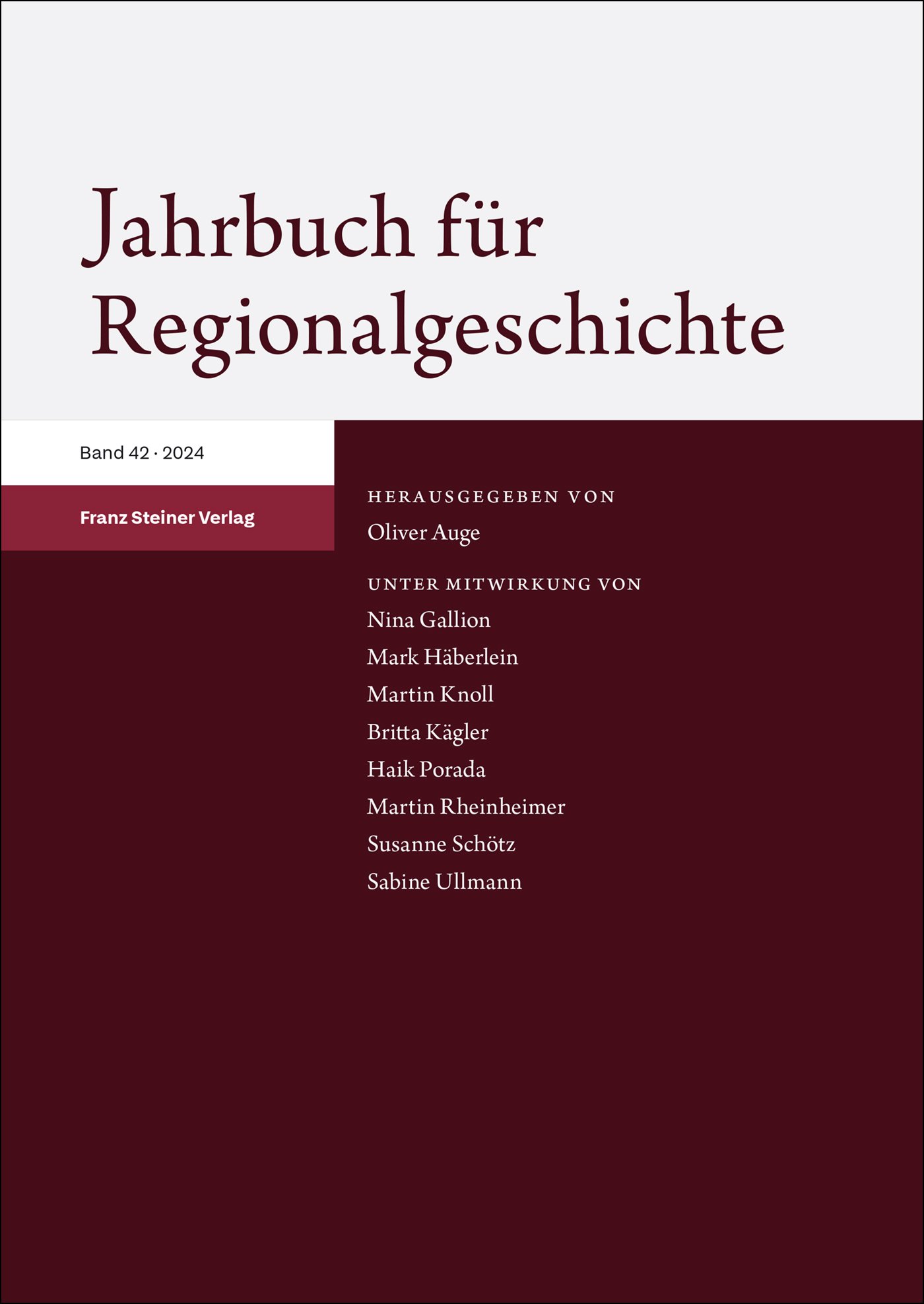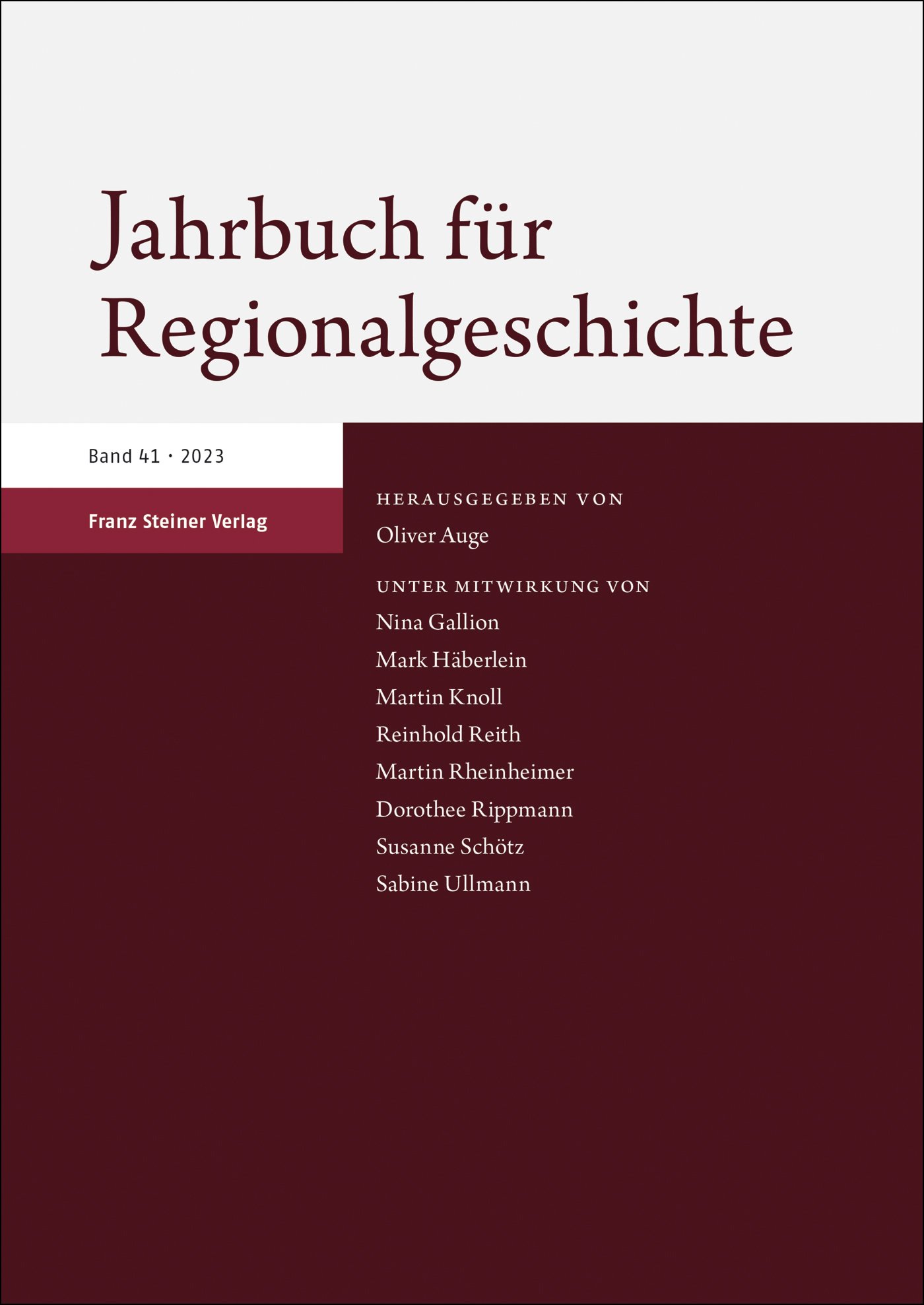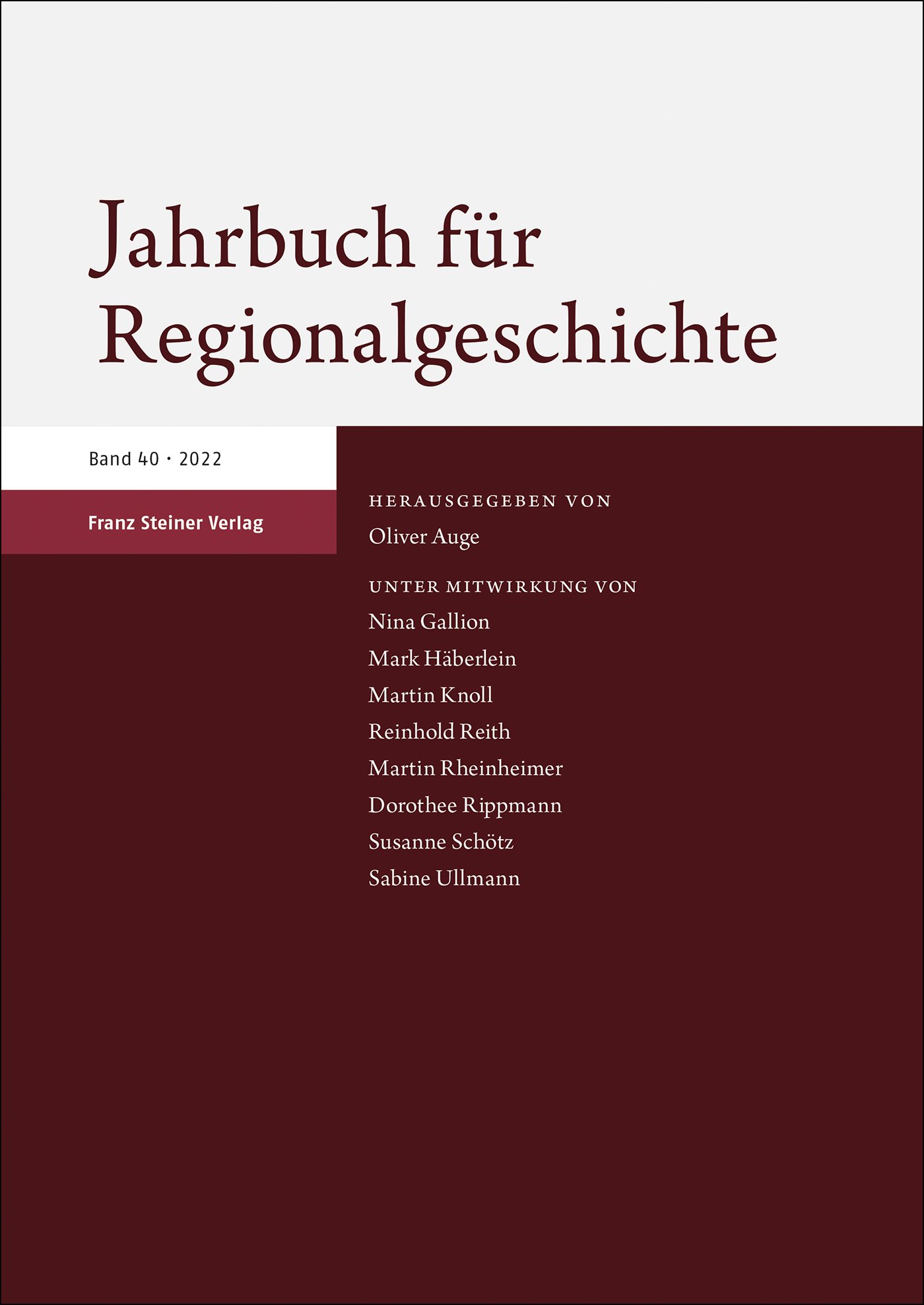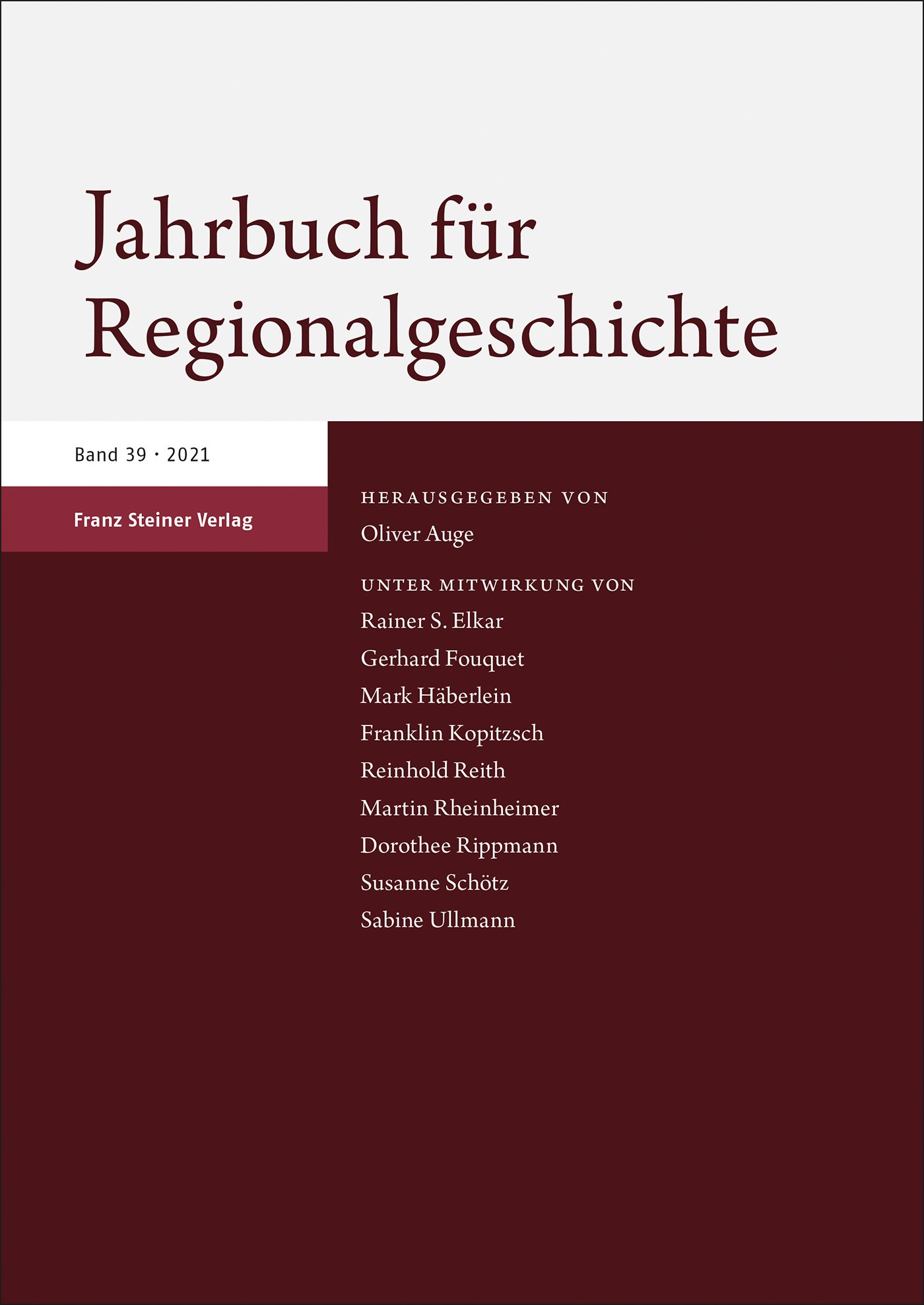
Jahrbuch fuer Regionalgeschichte
The Jahrbuch fuer Regionalgeschichte was established in 1965 by Karl Czok as a project of the Saxon Academy of Sciences. Originally, the yearbookʼs focus lay in the history of what are now known as the “new federal states” of Germany. After German reunification in 1989/90, the Saxon Academy turned editorial responsibility for the yearbook over to an independent editorial board.
The yearbook now sees its mission in providing a forum for regional history covering all of Central Europe. Because the concepts of territory and region are understood in a more inclusive sense, it prints not only contributions to territorial and national history, but also articles about economic, social, cultural and even political regions. Constitutive factors in the formation of regions are of particular interest, extending to climate, migration, trade and communications as well as cooperation and conflict between political players.
Edited by

Prof. Dr. Oliver Auge
(executive editor)
Universität KielHistorisches Seminar
Abteilung für Regionalgeschichte
Olshausenstr. 40
24118 Kiel
DEUTSCHLAND oauge@email.uni-kiel.de
Editors
Oliver Auge
Nina Gallion
Mark Häberlein
Britta Kägler
Martin Knoll
Haik Porada
Susanne Schötz
Sabine Ullmann
Editorial office
Christian Hoffarth
Benedikt Schmitt
Annika Spingler
Samuel Wüsten
Universität Kiel
Historisches Seminar
Abteilung für Regionalgeschichte
Olshausenstr. 40
24118 Kiel
DEUTSCHLAND
jbrg-redaktion@email.uni-kiel.de
Founded by
Karl Czok
Jahrbuch für Regionalgeschichte
General information
ISSN 1860-8248 (print)
ISSN 2748-2529 (online)
Founded: 1965
Publication frequency: annual
Size: 17 x 24 cm
Annual number of pages: ca. 224
Languages: English, German
Review section: Yes
Validation: peer review
- Dietrich’s Index Philosophicus
- ERIH – European Reference Index for the Humanities
- IBZ / IBR
- PIO – Periodicals Index Online
- SJR – Scimago Journal & Country Rank
- Scopus
- Historical Abstracts
- Ulrichs web
- H-Soz-Kult
Publishing information
Please send manuscript submissions to the editor-in-chief. Submissions must be original articles (no translations) which must not be previously published. During the review process, manuscripts may not be submitted elsewhere. A manuscript submitted to the journal must be ready for publication, the editors do not accept partial or draft versions. In initial submissions, the citation rules of the journal do not have to be strictly followed. Please pay attention to the anonymization of your text so that your identity as author cannot be ascertained directly or indirectly (e.g. by acknowledgments and self-references in footnotes).
All submissions are subjected to peer review. The review process can result in acceptance, the recommendation of revisions or rejection of the manuscript. The author is informed of the decision by email. The editors attempt to reach a decision within 3 months of the submission of the manuscript.
If a manuscript is accepted, the editors request a file with the final version. The final version includes names and acknowledgments. Also, please follow the guidelines of publisher and editors provided below.
There are no fees for submitting and publishing an article in the Yearbook.
In our area for authors you will find all the general information you need about structuring your article, formatting your text, working with images and tables and so on. Here we have linked the most important pages for you:
- Technical requirements
- Contribution guidelines
- Text body
- Figures and images
- Tables
- Lists and bibliography
- Use of AI
Additional editorial information and citation guidelines
General notes
- Source citations in the body of the text are set in italics without quotation marks.
- Direct quotations from secondary sources are set in the body of the text in double quotation marks and in the correct case.
Contribution header
- General guidelines on the contribution header can be found under ‘Contribution guidelines’.
- The title in the original language is followed by the English translation of the title, unless the title is already in English.
- Contributions in the Jahrbuch für Regionalgeschichte include an abstract and keywords in the original language, as well as an abstract and keywords in English.
Abbreviated references in the footnotes
- The bibliography, containing detailed source references and bibliographic citations, appears at the end of each article; footnotes include only the abbreviated title.
- Multiple authors are separated by commas.
- Instead of repeating a name directly, please use “ibid.” or “op. cit.”
- Two consecutive pages are cited with “f.”; more than two pages are cited with a range:
22 f. (corresponds to pp. 22–23)
22–27
not 22 ff. - The short title is given as follows: Last name: Short title, page number.
Hintrbänkler: Parliament, 245.
Bettelmann: Almosenempfang, 125.
Bibliography
- Please do not use abbreviations for journal or series titles.
Monograph
- First Name Last Name: Title. Subtitle (series, if applicable), Place Year.
Alois Hinterbänkler: The Dilemma of Parliament in New Greenland, Ochsenhausen 2002, 245.
Article from a Journal
- First Name Last Name: Title. Subtitle. In: Journal Title, Volume (Year), Issue, page numbers.
Elvira Schönschreiber: Das doppelstöckige A zwischen 800 und 810 und seine kalligraphischen Deutungsvarianten. In: Zeitschrift für Karlsschriften 99 (2003) 8, 121–129.
Articles from an edited volume
- First Name Last Name: Title. Subtitle. In: First Name Last Name (ed.): Title. Subtitle, Place Year, page numbers.
Ingrid Schwetzer: Fundamentales über die Rolle der Bedeutung. Genesis und Perspektiven. In: Paul Vielredner, Edwin Abnicker (eds.): Die Kunst der politischen Überzeugungsbildung, Blasenbach 2002, 965–980.
Online source
- First Name Last Name: Title. Subtitle. In: Title of the online journal, Volume (Year), Issue, page numbers if applicable. DOI [or] URL; accessed: DD.MM.YYYY.
Fred Everett Maus: Defensive Discourse in Writing about Music. In: Zeitschrift der Gesellschaft für Musiktheorie 17 (2020) 1, 75–80. DOI:10.31751/1035.
Eva Schlotheuber: Offener Brief zur Einstellung der Radiosendung ZeitZeichen auf NDR Info. https://www.historikerverband.de//mitteilungen/mitteilungs-details/article/offener-brief-zur-einstellung-der-radiosendung-zeitzeichen-auf-ndr-info.html; access: 25.06.2020.
Please see our information on copyright, self-archiving rules and guidelines for the use of PDF reprints here:
For our publication ethics statement have a look here:
Discover the journal
Subscribe
For institutions: Do you wish to subscribe to Jahrbuch für Regionalgeschichte? Please get in contact with us and write to us here:
For private customers:
Latest issues
-
€64.00*
-
€64.00*